Before Users Notice: Turning Monitoring Warnings into a Head Start
Many infrastructure alerts need no action. Learn how a meaningful warning can become an informed response before users experience an interruption.
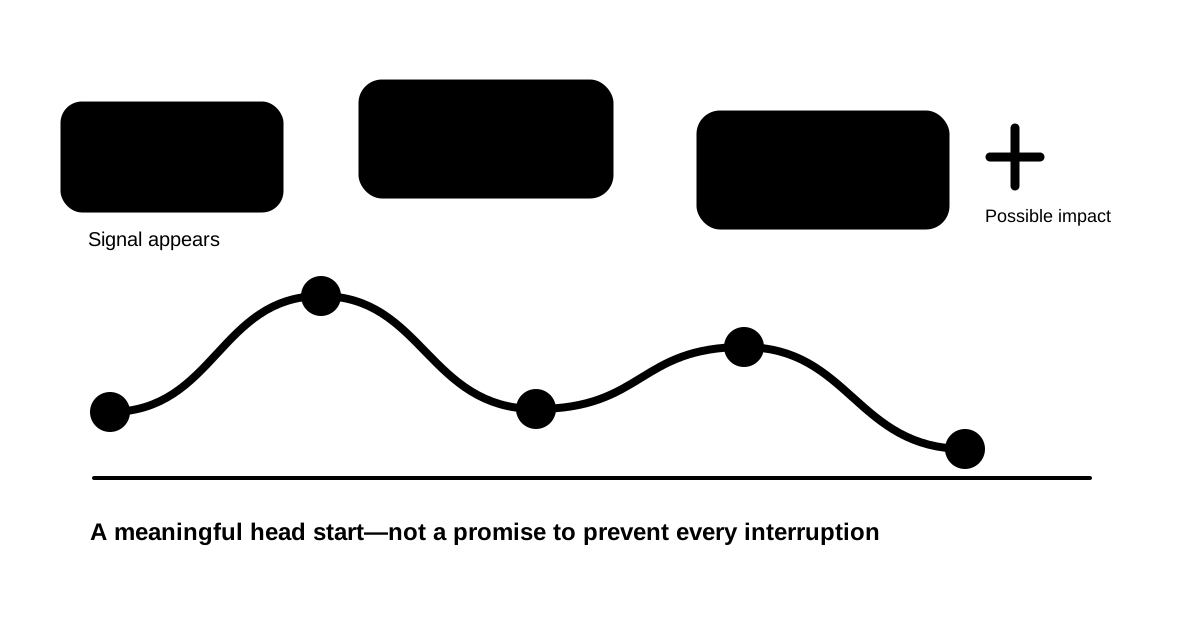
Monitoring gives a team a view of what its systems are doing. It does not automatically tell the team which changes matter to the people who rely on those systems, or what to do next.
That distinction is easy to miss when an alert queue grows. Many alerts describe a brief change, a condition the organization has chosen to accept, or something that clears without intervention. Treating every observation as a task can exhaust the people who respond. Treating every alert as background noise can leave a meaningful warning unattended until an employee or customer reports an interruption.
The frustrating pattern is familiar: a support request arrives, the team begins investigating, and someone later finds monitoring had already recorded clues. The system saw a condition; the organization did not yet have a process that turned it into a useful response. The opportunity is not to promise that every issue can be prevented, but to connect early evidence with the people able to assess it.
A warning is a chance to understand service impact
The useful question is not “How many alerts did we receive?” It is “Which conditions could affect a service, and what evidence would help us decide what to do?” Start with the service and its users. Name the people who depend on it, the technical and business owners, and conditions that could interrupt their work.
Context matters because the same infrastructure signal may have different implications in different environments. A short resource spike during a planned batch job may be acceptable. The same pattern during a period of high demand may deserve investigation. A warning on a supporting component may not yet affect users, but it may reduce a service’s ability to handle the next workload. The team needs to distinguish an early clue from confirmed impact.
Then define what the team needs to know before a warning becomes an incident. Duration, recurrence, recent configuration changes, related signals, and the affected dependency can all change the decision. A single measurement without context may be only an observation. A repeated pattern tied to a service concern may be worth attention.
Connect the warning to a person’s work
To understand whether a warning matters, describe the workflow it could affect. For a campus service, this might be access to a course application; for a healthcare environment, a staff workflow that depends on a virtual desktop; for a public-sector office, an employee service needed to process work. These are examples of the kinds of dependencies teams should map, not claims about a particular customer environment.
Ask the service owner what a user would notice first. Would the application become unavailable, would a task take longer, or would only a background process be affected? The answer helps responders interpret evidence in practical terms. A monitoring metric is more actionable when the team can explain how it relates to a workflow and what further signal would strengthen that connection.
Keep the time sequence clear. Record when the warning began, whether related conditions appeared earlier or later, and whether a recent planned change might explain it. If users have reported a problem, preserve the timing and scope of those reports without assuming that correlation proves a cause. This timeline lets a teammate compare what monitoring observed with what users experienced.
Turn meaningful evidence into a response path
When a condition deserves attention, a team needs more than another notification. A useful workflow should:
- Connect the warning to a service. Identify the application, users, dependencies, and service owner.
- Gather supporting evidence. Review relevant health signals, logs, recent changes, and related events. Keep the timeline clear.
- Separate facts from hypotheses. State what is known, what may explain the condition, and what still needs checking.
- Prepare a proportionate next step. Explain why it is worth considering and what operational impact it may have.
- Reach an accountable decision. The team determines whether and how to respond based on evidence and responsibility.
That sequence gives a responder a better starting point than a raw alert. It also makes the decision easier to hand off: the next person can see what was observed, what was investigated, and why the team chose a particular response. If the evidence remains incomplete, the workflow should preserve that uncertainty instead of presenting an assumption as a diagnosis.
Where Overwatch fits
Logical Front’s Overwatch is designed to help identify alerts worth addressing and investigate them. It has automated-remediation capabilities, as well as the ability to prepare proposed responses for team consideration. These capabilities do not mean every alert automatically triggers remediation. The appropriate response depends on the condition and operating context; some cases may call for engineer review of evidence and a proposed step. Do not infer an exact deployment default or approval control from the existence of the capability.
The potential benefit is not simply a shorter alert list. It is the opportunity to notice meaningful trouble earlier, assemble relevant context, and reduce duplicated investigative effort before a user report becomes the first useful clue. A response path should make clear what was observed, what is uncertain, and what happened after a decision, whether a person acted or an automated capability was used.
That is a chance to address a problem before users notice—not a guarantee that every interruption will be prevented. Some conditions develop too quickly, some evidence is incomplete, and some decisions depend on people who understand the service and its consequences. A responsible process makes these limits visible rather than promising certainty.
Make the head start operational
Teams can begin without changing every monitoring rule at once. Choose an important service, agree on what user impact looks like, and review a small set of recurring warnings. Identify which evidence would make a condition worth investigating and who understands the affected workflow. Keep the initial process simple enough that responders can follow it during a busy day.
For each reviewed warning, record the signal, context, classification, owner, and reason for the next step. Where there is a relevant proposed response, note its expected effect and what should be observed afterward. If the team decides not to intervene, retain the reason and any condition that would prompt reconsideration. Revisit the process after a significant service change or when new evidence appears.
A warning should not become an incident solely because a threshold was crossed. Equally, an alert that has not yet produced a user complaint is not automatically harmless. The responder should assess the signal against the service’s current state and determine whether more observation, investigation, or action is appropriate.
Learn whether the process creates a useful head start
Do not judge the process by alert count alone. A lower count could mean the team improved its rules, or it could mean useful signals stopped reaching the people who need them. Review a sample of events with the service owner and ask whether classification and response made sense.
Useful observations include how often a warning led to investigation, whether the team found a meaningful service concern, and whether monitoring or a user report surfaced the issue first. These are measures of workflow, not promises of a particular reduction in incidents or response time. Establish a baseline before changing the process, then revisit it after enough examples have accumulated. Look at both warnings that led to action and those that did not.
When a user report arrives before monitoring prompts a review, ask what the report revealed that the existing signals did not. Perhaps the service impact was not represented in the technical alert, the relevant warning was routed elsewhere, or the threshold was not useful for that workflow. Record the gap and decide whether it is appropriate to improve the signal, its context, or the route to an owner. Do not change rules solely to make the dashboard appear quieter.
Start with a bounded workflow
Choose one service with a clear owner and a recurring alert pattern. Review past examples and determine what was visible before user impact, what the team learned afterward, and which information would have helped the earlier decision. Agree on what evidence a responder needs and who is responsible for deciding on a response. Keep the scope small enough to review outcomes and adjust without changing every alert rule at once.
Include an exception path. If a warning suggests possible user impact but evidence is incomplete, the responder needs to know whether to gather more information, contact the service owner, or continue observing. A clear route for uncertainty is safer than forcing every case into a simple yes-or-no classification.
After the trial, review cases that triggered action and cases that did not. Did the process surface useful context? Was a decision delayed because the right owner was missing? Did users report an issue before the team had a reason to investigate? Use those findings to improve the operating practice, not to imply that monitoring can always predict the future.
The goal is a repeatable path from a meaningful warning to an informed response. Many infrastructure alerts need no action, but a meaningful warning should not have to wait for a complaint to become visible. For teams evaluating how infrastructure signals can support that workflow, see Logical Front’s Intelligent Infrastructure overview.
Logical Front today
Practical AI for infrastructure operations
Logical Front combines 24/7 monitoring and automated diagnosis with Overwatch response recommendations and automated remediation for well-understood incident classes. Teams can begin in watch-only mode and advance automation deliberately; not every alert triggers an automatic change.
Put AI to work in infrastructure operations
Discuss a controlled path from AI experimentation to monitored production operations.
Discuss AI Operations