From Alert to Proposed Response: Give Engineers an Investigation to Review
An alert is not a diagnosis. Learn how evidence, context, uncertainty, and a proposed next step help teams respond without starting each investigation from scratch.
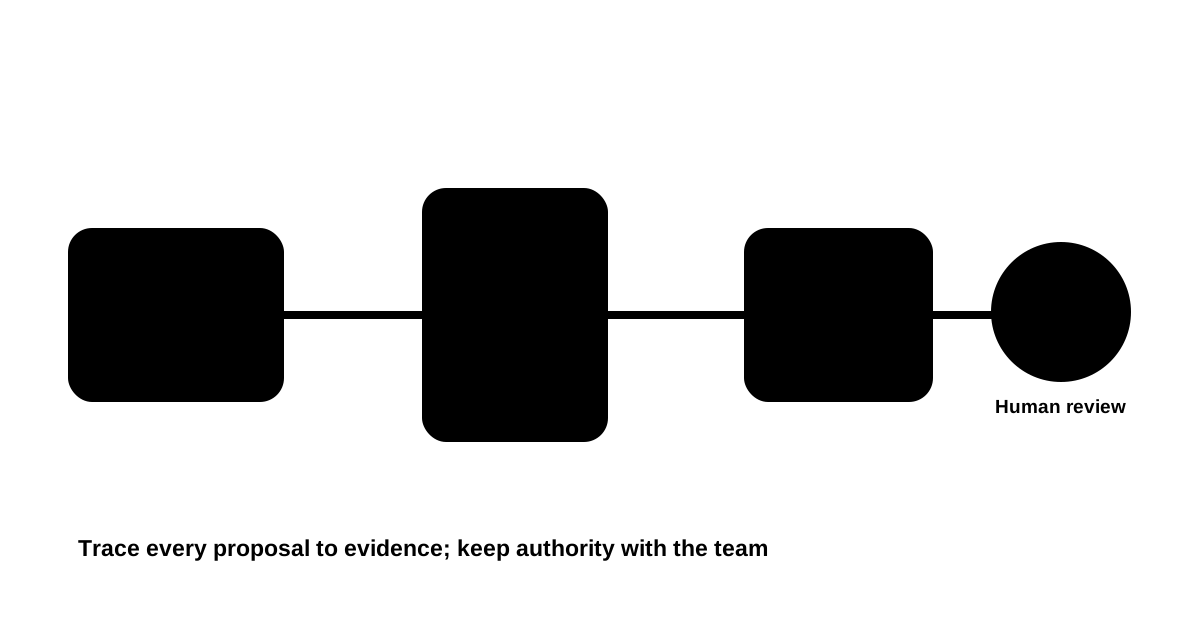
An alert tells a team that something changed. It does not, by itself, explain what is affected, why it happened, or what to do next.
Engineers still have to gather evidence, compare related symptoms, check recent changes, understand service dependencies, and decide which explanation the evidence supports. When that investigation lives in separate tools or in one person’s memory, the next responder may have to reconstruct it under pressure. The business waits while the team works out what the signal means.
The goal is not to replace the people who know the environment. It is to give them a better starting point: a concise, reviewable account of what was observed, what was investigated, and what response may be worth considering.
Keep evidence and interpretation distinct
An investigation is more useful when it separates what the team knows from what it suspects. Start with the original alert and the time it appeared. Then gather the context that could change the interpretation: the affected service, related signals, recent configuration changes, dependencies, and whether users have reported impact.
Record evidence in a sequence that another engineer can follow. If the system was changed shortly before the alert, note the change and whether the timing is relevant. If related signals appear on multiple components, show how they are connected. If a piece of evidence is missing, say so. A hypothesis is not a confirmed root cause simply because it fits the first symptom.
This discipline protects the team from two common mistakes. One is treating the first plausible explanation as fact. The other is delaying every decision until every possible cause has been ruled out. Clear evidence, uncertainty, and a proposed next step let the team choose an appropriate action without overstating confidence.
Build a response record someone else can review
A useful response record answers five questions:
- What was observed? Preserve the signal, source, time, and relevant service.
- What may be affected? Identify users, applications, dependencies, and current service state.
- What evidence supports the interpretation? Include related signals, recent changes, and checks completed.
- What remains uncertain? Name the missing information or competing explanations.
- What response should the team consider? Explain the next step and its expected operational effect.
The last question should not turn a proposal into an instruction. Some responses are safe to take quickly; others affect production, users, or recovery. The people responsible for the service should review the evidence and decide whether and how to proceed. If the response is not appropriate, the team should be able to reject it without losing the investigation record.
Reduce repeated work, not human judgment
A well-prepared case saves time in a specific way: the next responder can review context instead of assembling the entire investigation from the beginning. It also makes handoffs clearer when an incident crosses shifts or teams. A person unfamiliar with the first investigation can see what has been checked and what the team decided.
That does not mean every alert deserves a full investigation. Many alerts may describe temporary, acceptable, or self-resolving conditions. Teams should first decide which conditions are worth addressing. For those that are, the investigation should be proportional to the service impact and the risk of the proposed action.
Overwatch has automated-remediation capabilities, alongside its ability to investigate alerts and prepare proposed responses. That capability should not be confused with every alert or recommendation automatically triggering a change. Whether an automated remediation is appropriate depends on the condition and the organization’s chosen operating approach; in other cases, an engineer reviews the evidence and proposed response. Avoid assuming an exact deployment default or approval mechanism without confirming it for the environment. The investigation record remains valuable because it makes the basis and context of a response easier to understand.
Ask what the evidence actually proves
When evaluating any incident-response tool, ask to see how it handles an incomplete case. Does it identify what is known and what is uncertain? Can a reviewer trace the proposed response to supporting evidence? Is the decision path understandable to the people responsible for the service? Does the record preserve the team’s decision for a later handoff?
Those questions are more useful than asking whether a tool can produce a confident-sounding summary. Under pressure, confidence without evidence creates risk. A reviewable investigation gives the team something to challenge, improve, or act on in a way suited to the case.
Set the operating scope thoughtfully
Teams should understand what the system observes, what it can recommend, and where automated-remediation capabilities may be relevant. Start with the services and conditions the organization wants to address. For each, consider the consequence of an action, how the condition is recognized, and how the result can be checked. Decisions about operation should fit the organization’s environment and established service responsibilities.
Do not treat a confident recommendation as permission to make a change. The service owner and the organization’s change process determine how an action is considered. A reviewer may ask for more evidence, choose a different response, or escalate when the potential impact exceeds the team’s knowledge or authority. Likewise, the existence of automation capability does not establish that a particular action is enabled in a particular deployment.
Review the investigation as an operational record
After a case closes, capture the original alert, evidence considered, response proposed or taken, and observed result. Note whether the condition cleared, required further work, or remains under observation. This record supports a later handoff and helps the team distinguish a useful investigation from one that merely restated the alert.
Use those records to improve the workflow. Repeated missing context may point to a monitoring or inventory gap. Repeatedly unsuitable proposals may show that the response approach needs revision—or that evidence is not strong enough to support a suggested action. Review a representative sample with service owners and keep decisions within the organization’s governance.
The practical measure is whether the team can reach and explain a sound decision with less duplicated investigative effort. It is not whether a tool can produce an answer for every condition.
A practical review sequence
The reviewer can use a consistent sequence for each case. First, restate the condition and the service that may be affected. Next, identify which evidence supports the investigation and which details remain uncertain. Then compare a proposed action with the service’s operating procedures, dependencies, and likely impact. Finally, decide what should happen next and record the reasoning in a form useful to the next person.
If a response involves a system change, consider its expected effect and what would indicate that the outcome differs from expectations. If the evidence does not support the proposal, gather more information or choose a proportionate observation path. When the right decision-maker is unavailable, follow the organization’s established escalation practice rather than assuming a decision has been made.
This sequence gives experienced operators room to apply judgment while making the decision easier to explain to a colleague, auditor, or service owner later.
Keep uncertainty visible
An investigation may find a likely cause without proving it. Label an inference as an inference, note what evidence would strengthen or weaken it, and distinguish a proposed next step from a completed action. Clear language reduces the chance that a future handoff treats an unverified explanation as fact.
For organizations evaluating how to connect infrastructure signals with informed responses, see Logical Front’s AI Operations Center overview. A useful investigation does not need to be elaborate: it needs enough context for another person to understand what happened, what remains unknown, and why the next step is being considered.
Logical Front today
Practical AI for infrastructure operations
Logical Front combines 24/7 monitoring and automated diagnosis with Overwatch response recommendations and automated remediation for well-understood incident classes. Teams can begin in watch-only mode and advance automation deliberately; not every alert triggers an automatic change.
Put AI to work in infrastructure operations
Discuss a controlled path from AI experimentation to monitored production operations.
Discuss AI Operations