Not Every Alert Is an Incident: Which Conditions Deserve Attention?
A useful alert process classifies temporary, acceptable, and self-resolving conditions so teams can tune signals and focus investigation where it matters.
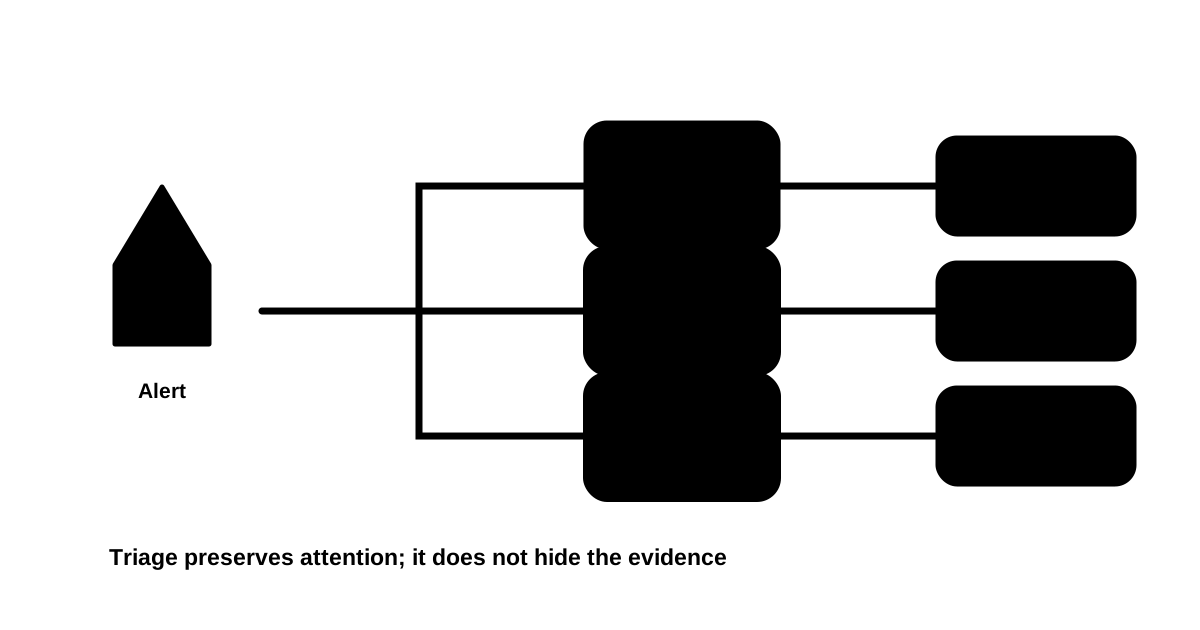
An alert is an observation. It is not automatically an instruction to fix something.
That distinction is easy to lose when an operations team sees a long queue of warnings. Some describe a temporary state. Some are accurate but acceptable. Some clear without anyone intervening. A smaller number may point to a developing issue that deserves investigation. Treating every alert as work wastes attention; treating every alert as noise leaves the team relying on a customer or employee to identify which problem mattered.
The goal is not to minimize alert count at any cost. It is to make sure signals are classified consistently, useful warnings remain visible, and responders understand why a condition deserves attention.
Give each signal a service context
Start by connecting an alert to the service people use. A device name or metric is not enough. Ask which application, department, workflow, or business service could be affected, and identify the person responsible for deciding whether the condition matters.
Context changes how a team interprets a signal. A short-lived change during planned maintenance may be expected. A similar change that repeats at another time may deserve attention. A high resource reading on a system with headroom may not require action; the same reading on a service with a sustained response-time problem may be a clue.
Context should be recorded rather than left to memory. Recent changes, time of day, duration, recurrence, related signals, and service dependencies help the next responder understand why the team chose to investigate—or why it did not. Without that context, a rule can look consistently noisy when it is actually reporting a recurring, limited impact that only the service owner recognizes.
Use a practical classification
For each alert family, decide what kind of condition it represents and what response is appropriate:
| Condition | Typical treatment | Question to record | |---|---|---| | Temporary state | Observe or retain as telemetry | Did it clear within the expected period? | | Accepted condition | Document the service owner’s decision | What impact or threshold would change the decision? | | Self-resolving condition | Confirm the recovery pattern | Is it safe to leave alone, and should it still be recorded? | | Condition worth investigating | Gather context and assign an owner | What evidence supports a response? |
The classification is not a permanent verdict. An accepted condition may become important after a service change. A self-resolving state may need investigation if it becomes frequent or begins to affect users. A condition worth investigating may turn out harmless after evidence is reviewed. The process should make it easy to revisit a decision when the environment changes.
Define what makes an alert actionable
A responder should be able to understand why the signal matters, what evidence is available, and who owns the next decision. If an alert cannot answer those questions, it may be better treated as an observation for review rather than as an immediate task.
Teams can use a few practical tests:
- Impact: Is a service or user workflow degraded, or is the alert only reporting an internal measurement?
- Duration: Has the condition lasted long enough to exceed an agreed threshold?
- Trend: Is it recurring, worsening, or correlated with a recent change?
- Ownership: Who can determine whether intervention is warranted?
- Response: If action is needed, is there a suitable next step?
These tests should be specific to the service. A threshold that works for one application may create noise or miss a meaningful change in another. Review alert definitions with people who operate the affected service, not only those who configure the monitoring tool. Make a rule understandable enough that a responder can tell what it is measuring and why its threshold exists.
Tune rules without losing useful history
When an alert repeatedly turns out to be harmless, review the evidence before changing its threshold or suppressing it. Is the condition expected for this service? Does it resolve on its own? Is the alert missing context that would make it easier to classify? A change that reduces noise for one service can hide a real problem elsewhere if the rule is applied too broadly.
Keep a record of why a rule changed, who made or approved the decision under the organization’s process, and when the team will revisit it. A temporary maintenance exception should have an end point. A lasting threshold adjustment should be checked against later events to confirm useful warnings still surface. Preserve underlying event history according to the organization’s practices; a quiet dashboard should not erase evidence needed to understand a later incident.
Tune one aspect at a time when possible. If a team changes the threshold, routing, and suppression window together, it may be difficult to understand why the alert volume changed or whether a meaningful event was missed. Compare samples before and after the change, including cases that did not generate a response. The absence of a ticket does not prove that the new rule performed well.
Close the loop after review
When a responder investigates an alert, record the outcome: the condition cleared, it was accepted, more monitoring is needed, or a response was considered. If it did not warrant action, consider whether its threshold, context, or presentation should change. If it did, capture evidence and reasoning so the next responder does not start from nothing.
This is not an argument for hiding warnings. A quiet queue is useful only if meaningful issues remain visible. Review a sample of events with the service owner, including alerts that were dismissed, to check that the classification still reflects the service’s needs.
Overwatch can help investigate alerts and has automated-remediation capabilities. That does not mean every event is automatically remediated. Classification and tuning remain important: teams need to identify which alerts merit attention, and the appropriate response depends on the condition and operating context. In relevant cases, engineers can review proposed responses; automation capability should not be mistaken for a claim that every operational decision is automated.
Give the signal a human owner
Every alert category that can affect an important service should have a clear route to a responsible person or team. That owner can explain which conditions are expected, what evidence matters, and who is responsible for response decisions. If ownership is unclear, resolving that gap may be more valuable than adjusting the alert itself.
For a new or ambiguous signal, record the uncertainty and choose a proportionate next step. A responder might gather more context, notify the service owner, or continue observing. The decision should reflect possible impact and evidence quality—not the assumption that every alert must immediately become a change request.
Review the alert policy after service changes, recurring incidents, or a pattern of user reports that monitoring did not surface. This keeps the process responsive while protecting against opposite mistakes: treating every signal as urgent or hiding warnings because they are inconvenient.
Review outcomes across the service
A condition that is routine during planned maintenance may deserve attention at another time; a brief fluctuation may be harmless on one service but meaningful on a different one. Include the service owner when deciding what an alert means, and make relevant operating context available to the responder.
After review, distinguish what happened from what the team inferred. Record whether the alert cleared, whether a dependency was affected, and whether a person confirmed user impact. If evidence is missing, state that plainly and choose a follow-up that can resolve uncertainty. This gives the next responder a useful starting point without turning a guess into an accepted fact.
When alert patterns repeat, review them as a group. The team may discover a missing maintenance annotation, an overly broad threshold, an ownership gap, or a genuine recurring condition. Make a controlled change and assess its effects before applying it across unrelated systems.
The value of classification is not a lower number by itself. It is a more defensible understanding of what the team is seeing and how its response rules fit the service. Learn more about Logical Front’s Intelligent Infrastructure approach to infrastructure operations.
Logical Front today
Practical AI for infrastructure operations
Logical Front combines 24/7 monitoring and automated diagnosis with Overwatch response recommendations and automated remediation for well-understood incident classes. Teams can begin in watch-only mode and advance automation deliberately; not every alert triggers an automatic change.
Put AI to work in infrastructure operations
Discuss a controlled path from AI experimentation to monitored production operations.
Discuss AI Operations