Cloud Exit Readiness: Test Before Moving
Before moving a workload, map dependencies, licensing, data movement, recovery, and rollback so the exit plan is tested—not assumed.
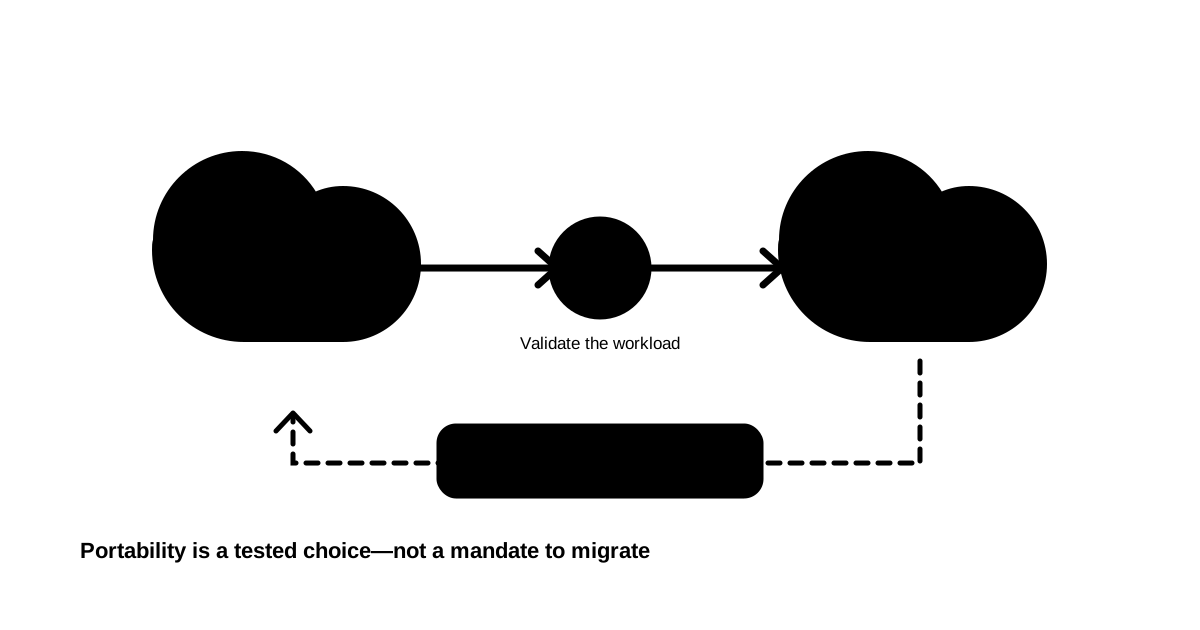
An exit plan is more than a list of virtual machines. A workload depends on identity, network routes, storage, licensing, integrations, operational skills, and recovery. Discovering those dependencies only after a move begins can create avoidable delay and risk.
Not every workload should leave its current environment. The practical question is whether the organization can move a workload safely if its needs or current arrangement change. A tested exit path improves that choice even when the decision is to stay.
Map the workload and its owners
Start with the service owner and people who operate the application. Record what the workload does, when it is used, who depends on it, and which systems must be available at the same time. A server inventory alone can miss identity paths, integrations, and interfaces that exchange data externally.
Include applications and data stores; user and administrator authentication; network routes, DNS, firewall rules, and external connections; licensing and vendor support terms; and backup and recovery dependencies. Ask the service owner to confirm the map. An unknown dependency is a migration risk, not an implementation detail to postpone.
Map the data as well as the systems. Estimate its volume, change rate, and transfer options using actual usage rather than assumed costs. Review contract terms for egress, support, renewal, and data retrieval. Determine how data consistency will be maintained during migration: a maintenance window, replication, or an application-specific process may be appropriate. Decide who confirms the destination copy is current and how the team prevents conflicting writes. Verify licensing and support conditions with the vendor before committing to a schedule.
Compare destinations against real requirements
Compare performance needs, control, recovery, licensing, data movement, security responsibilities, team skills, monitoring, maintenance, and vendor relationships. The cheapest compute estimate is not the whole operating model. Include migration effort, ongoing operations, necessary network changes, and recovery arrangements where applicable; state assumptions and keep unresolved questions visible.
A workload may remain in place, move to another public or private environment, or use a hybrid design. Choose based on service requirements and evidence, not a universal claim that one model is always cheaper or safer. The organization’s legal, procurement, security, and service owners may each need to review distinct requirements such as data location, retention, audit evidence, support expectations, and licensing.
Design a pilot that answers a decision
Choose a representative workload whose owner can explain users, dependencies, data flows, recovery needs, and acceptable maintenance windows. Define scope, baseline, success conditions, and what the pilot cannot prove. Confirm that the destination supports actual requirements; do not assume a virtual machine or container behaves identically everywhere.
Validate the access path, application workflows, integrations, relevant performance expectations, access controls, data version, backup and recovery steps, and operational responsibilities. Have a user or service owner test the work that matters, not just whether a machine starts. Check logs and application behavior, and ensure the team knows how to operate the target. A single pilot cannot establish that all applications can move, that cost will fall, or that security is automatically improved.
When evidence exposes a gap, decide whether to address it, alter the target, or stop. Record the finding and its owner. This makes a pilot useful even when it disproves an assumption: it prevents a broad migration from repeating the same mistake.
Set transition and rollback boundaries
Before a move, identify conditions to pause, proceed, or return to the original environment. Name who may make those decisions and who communicates them. Define which environment is authoritative at every stage, how changes made during transition will be reconciled, and what data-loss or downtime limits the approved objectives allow. Without a clear source of truth, rollback can create conflicting records.
Document the actual steps, access needed, communications, and provider responsibilities. Rehearse critical actions where practical, particularly those involving expiring credentials, external support, or time-limited network changes. Keep the original environment available until the service owner accepts the new path and retention and contract obligations are understood. A fallback is not a prediction of failure; it is a boundary that limits risk when assumptions prove wrong.
Assign the operating work
A new location changes who does the work. Identify who monitors the service, applies updates, manages identities, responds to alerts, maintains backups, and coordinates provider support. Confirm that those people have the necessary access and skills, or document the partner responsibilities on which the plan relies. Include support escalation paths and the evidence needed to hand work between teams.
At a review point after the pilot and before broad migration, ask the service owner to accept the result and support teams to confirm they can operate it. Recheck that rollback remains practical for the approved transition period. If a dependency or recovery mismatch remains unresolved, update the plan before committing more workloads. The right outcome may be a selective move, renegotiation, or remaining where the service is.
For a concrete planning artifact, keep a decision log with workload owner, source and target environments, assumptions, evidence, unresolved risks, and the decision date. Link each assumption to a way to test it: vendor confirmation for licensing, a measured transfer estimate for data movement, or a recovery exercise for restore steps. The log prevents estimates from quietly becoming facts as teams and timelines change. Revisit it when the service changes or when a contract renewal alters the available choices.
Before estimating schedule, ask what must remain available while the workload moves. A service with external integrations may require coordination with counterpart organizations; a user-facing system may need a maintenance notice and support coverage at cutover. Identify these constraints with owners early, because a technically sound transfer plan can still fail if its window conflicts with business operations. Document the dependency and the person who can approve timing.
Also distinguish reversible preparation from irreversible actions. Discovery, testing, and configuration review can usually proceed without committing the production workload. Data writes, contract termination, and deletion of the original copy may not be reversible. Mark those decision points explicitly and require the relevant owner to review evidence before crossing them. This sequencing keeps pressure to meet a target date from eclipsing basic safeguards.
Logical Front’s Cloud Managed Services can help teams assess infrastructure options and operating responsibilities. For another perspective on workload placement, see when cloud computing makes sense. A tested exit path gives decision-makers better information, whether they move the workload or leave it in place.
Logical Front today
Private cloud with an operating model behind it
Logical Front has delivered infrastructure since 2003. Today, the emphasis is predictable private cloud, Overwatch automated operations, and AI infrastructure that healthcare, education, and government teams can control.
Compare private-cloud options for your workloads
Review workload fit, operating requirements, and long-term economics with an infrastructure specialist.
Schedule an Infrastructure Review