Backup Completed; Recovery Untested: A Tabletop for Restoring a Critical Service
A backup is not proof of recovery. Use a tabletop to test dependencies, restore order, access, owners, and user validation before an outage.
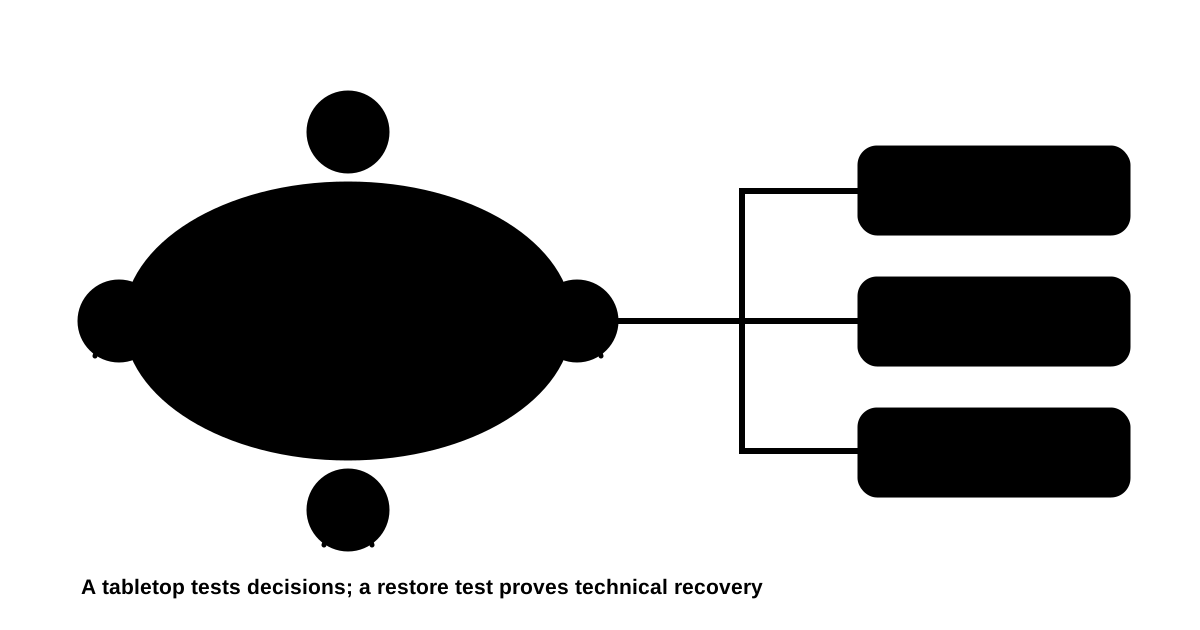
A successful backup job status shows that a job reported success; it does not prove the intended data and dependencies were included, that the copy is usable, or that a service can be recovered. A database may be present while identity is unavailable. A virtual machine may start while its application cannot reach required services. A service may pass a technical check while users still cannot complete their work.
A tabletop exercise lets an organization test its plan and decision paths before a disruption. It is not a technical restore test, but it helps reveal assumptions that a system-level test may not expose. Together, the discussion and a controlled restore test address different parts of readiness.
Choose a service and agree what recovery means
Select a service with a clear owner and business importance. Keep the first exercise narrow enough to complete. Invite the application and infrastructure owners, identity and network representatives, continuity or security participants as relevant, and a user representative who can explain what usable service means.
Use recovery objectives that the business and service owners have approved. Ask how much downtime the service can tolerate, how much recent data it can afford to lose, and which users or departments need access first. Do not substitute backup-product defaults for business decisions. Define evidence for recovery in advance: an application check, permitted user login, representative workflow, and confirmation that expected data is present may all be relevant. A running server is an infrastructure signal, not the final business test.
Walk the dependencies and decisions
Use the current service map to discuss what must be available before users can work: database, identity, network route, certificates, storage, external connections, and provider support. Ask which components must be restored first, who owns each, and where the team would obtain credentials and approved access if the normal environment were unavailable. Confirm who can authorize recovery steps and who communicates status to users.
Compare documentation with current architecture, recent changes, and actual ownership. Plans become stale when an integration is added, a contact changes, or responsibility moves between teams. When participants cannot identify an owner or dependency, record the gap instead of improvising an answer. An undocumented dependency is useful exercise evidence even before it is technically tested.
Introduce one complication at a time: the usual owner is unreachable, a provider contact has changed, the primary access route is unavailable, or a recovery copy may not include a recent configuration change. Ask participants what information they need, who decides whether to change course, and how that decision will be recorded. This tests whether the plan supports informed action rather than whether individuals can memorize instructions.
Keep the tabletop controlled
State the scope and scenario before participants arrive. Explain whether the discussion is intended to test declaration, authority, restore order, provider coordination, or user communication; a first tabletop need not cover every system. A facilitator can reveal developments gradually and note whether people know where to find a current contact, map, or approval. The aim is to improve the process, not to catch people out.
A discussion-only tabletop must not trigger production changes. Participants describe what they would do; they do not attempt a live restoration. Protect credentials and sensitive data, and capture decisions and questions rather than secrets. If the conversation identifies a technical assumption that needs testing, plan a separate restore exercise with appropriate scope, approvals, environment, and rollback arrangements.
Include communication in the scenario. Decide who tells affected staff that recovery is underway, how updates will be shared, and where users find an approved workaround. A technical plan that leaves people waiting without a status path is incomplete. Record who owns each communication and what information is safe and useful to share.
Turn findings into a technical test
At the close, distinguish documentation gaps, unclear authority, provider coordination, recovery access, and technical limitations. Agree an owner and an observable completion condition for each action. For example, a contact route is verified when another authorized team member confirms it works, not merely when someone edits a document. Record open questions separately from confirmed failures so that stakeholders understand what evidence exists.
Use the findings to scope a controlled restore test. Choose a component or service path that can be validated safely, identify dependencies, decide who observes the outcome, and plan how the test environment will be returned to its prior state. Confirm that the test uses the intended data and relevant configuration. Validate restore integrity, required dependencies, access, and the agreed workflow with the service owner. A successful component test proves only the conditions it actually exercised; do not claim it establishes recovery of the whole service unless the full path was tested.
Record actual steps and elapsed time if relevant to approved objectives, deviations from the plan, data or configuration checks, and user validation. Compare results with the objectives and assign remediation for gaps. A tabletop tests coordination and decisions; a restore test checks whether specified technical components and data can be recovered. Neither substitutes for the other.
Keep the plan useful after the exercise
Produce a concise readout with scenario, participants, decisions, observed gaps, and next actions. Update dependency information, runbooks, approval paths, and contact details where warranted. Treat changes to procedures like other operational work: identify the owner, communicate the updated guidance, and confirm that the people who will use it can find it.
Repeat or revise the exercise when service architecture, ownership, provider arrangements, or recovery design changes. Revisit the specific assumptions affected rather than repeating an unchanged scenario mechanically. Keep recovery documentation connected to the environment people actually operate, and make clear which conclusions are demonstrated versus still assumed.
When a finding affects several teams, keep one shared action reference and let each owner update its portion rather than circulating competing copies of the plan. At the next review, verify that decisions, revised contacts, and test evidence are still accessible to the people expected to act. A tidy document is not itself proof of recovery, but reliable ownership and current evidence make the next exercise more productive.
Logical Front’s Cloud Managed Services can help organizations plan and operate infrastructure recovery. A dependable recovery process is measured by demonstrated restoration and user validation, not by the existence of a backup report. For related guidance, see secondary data center recovery planning.
Logical Front today
Private cloud with an operating model behind it
Logical Front has delivered infrastructure since 2003. Today, the emphasis is predictable private cloud, Overwatch automated operations, and AI infrastructure that healthcare, education, and government teams can control.
Compare private-cloud options for your workloads
Review workload fit, operating requirements, and long-term economics with an infrastructure specialist.
Schedule an Infrastructure Review